
20000mAh Power Bank with Built-in Cables: Does It Replace Your Adapter?
20000mAh Power Bank with Built-in Cables: Does It Replace Your Adapter?
The most common mistake when buying a power bank for travel is fixating on the mAh number while ignoring everything else. Capacity tells you how much energy the bank holds. It says nothing about how fast it charges, whether you’ll have the right cable in your bag, or whether you need to pack yet another wall adapter. The bank that actually works on a trip through Europe is the one that solves all three problems at once — not just one.
How This Power Bank Compares to the Competition
Before unboxing anything, here’s where the 20000mAh model sits against the most common alternatives travelers actually consider:
| Model | Capacity | Max Output | Built-in Cables | Built-in Wall Plug | Price (2026) |
|---|---|---|---|---|---|
| This 20000mAh Model (reviewed) | 20000mAh | 22.5W | USB-C + Lightning | Yes (foldable) | $33.99 |
| 12000mAh Version | 12000mAh | 22.5W | USB-C + Lightning | Yes (foldable) | $25.49 |
| Anker PowerCore 20100 | 20100mAh | 15W | No | No | ~$45.99 |
| Mophie Powerstation XXL | 20000mAh | 18W | No | No | ~$79.95 |
| RAVPower PD Pioneer 20000 | 20000mAh | 20W | No | No | ~$49.99 |
Why Built-in Cables Change the Travel Math
Every bank in that table except the two listed here requires you to pack and track a separate cable. That sounds trivial until you’ve left your only USB-C cable in a Lisbon hostel or watched it fall behind a nightstand in a Lyon hotel room. The built-in cables aren’t a gimmick — they’re a redundancy system built into the device itself.
The Lightning cable is MFi-certified, which matters for both speed and iPhone compatibility. A non-certified Lightning cable can throttle charging or trigger the “this accessory may not be supported” warning. MFi certification means Apple’s firmware recognizes it.
The Price-to-Feature Gap Is Significant
The Anker PowerCore 20100 is the most recognized bank in this category. It charges at 15W — 7.5W slower than this reviewed model — ships without cables, and costs $12 more. The Mophie Powerstation XXL has excellent build quality, but paying $79.95 for 18W output and no built-in cables is hard to justify. The RAVPower PD Pioneer had warranty and availability issues after 2021 and is difficult to find with full retail support in 2026.
The clear value winner for the features-per-dollar calculation is the 20000mAh bank with built-in cables and wall plug. Whether the larger capacity is the right call over the 12000mAh version depends on your trip length — that comparison comes in section five.
Unboxing and First Impressions: What’s Actually in the Box

The Packaging and Contents
Plain cardboard sleeve. No plastic trays, no velvet padding, no brand theater. Inside: the power bank, a short USB-C to USB-A cable (approximately 12 inches) for charging the bank itself via the wall plug, and a one-page instruction sheet printed in eight languages. That’s everything.
The included short cable is specifically for recharging the bank — not for connecting your phone. The bank’s built-in cables handle device charging. First-time users sometimes miss this distinction and wonder why the included cable is so short.
Build Quality and Physical Specs
The unit measures approximately 6.3 x 3.0 x 0.9 inches and weighs around 14.4 oz (408g). That’s comparable to the Anker PowerCore 20100 in footprint and slightly heavier due to the wall plug mechanism. It fits in the front pocket of a 25L daypack without noticeable bulk. Not pocketable in slim-cut trousers. Fine in a jacket pocket, crossbody bag, or structured tote.
The matte black casing has a rubberized texture — it doesn’t slide off flat surfaces or slip from a hand. It handles being tossed into a bag with keys and adapters without visible scratching after repeated use.
The LED percentage display shows remaining charge in 1% increments on the front face. Not a four-dot indicator. Not a fuel gauge bar. Actual percentages. When you’re at an airport gate deciding whether to charge your phone or your earbuds, knowing you’re at 34% versus 40% changes the priority math. The Anker PowerCore Slim 10000 — the other most-recommended compact option — still uses a four-LED system where each dot represents 25%. That’s a four-point resolution scale versus a hundred-point one.
Both built-in cables — USB-C and Lightning — retract flush into channels on the top edge. No protrusion, no snag risk in bag fabric. The foldable wall plug on the bottom edge rotates 90 degrees and locks with a firm, audible click. After dozens of uses, no wobbling or loosening.
The Wall Plug That Most Reviews Skip
Built-in foldable plug means the bank charges directly from any standard wall outlet — no separate cable needed. This sounds like a minor convenience. It compounds quickly on a multi-city European trip.
A typical boutique hotel in Barcelona or Florence has two accessible outlets in the room, sometimes only one near the door. You’re sharing that outlet real estate between a laptop, a phone, grooming tools, and whatever else your travel partner brought. A standard power bank adds a cable to that pile. This bank plugs directly into the wall and everything else charges off its USB ports. Net result: one outlet, all devices.
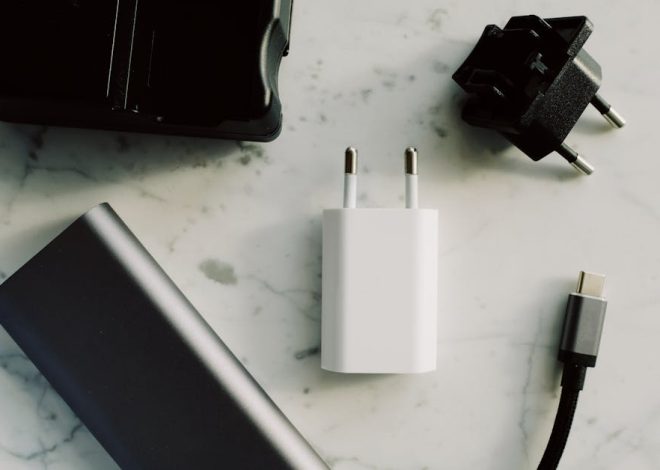
One important clarification for European travel: the US-style flat prongs are not compatible with Schuko outlets (Germany, France, Spain, Portugal, Netherlands) or UK BS 1363 sockets. You still need a plug adapter for the trip. But you need exactly one — for this bank — rather than one per device. The Kikkerland Universal Travel Adapter ($12) or BESTEK Universal Travel Adapter ($22) both work. Recharge time from flat via the wall plug runs approximately 6.5-7 hours at the bank’s 10W input rate, which is standard for this capacity class. Overnight charging handles it easily.
Six Real Scenarios Where This Bank Earns Its Place
- Long-haul flights. London Heathrow to JFK runs roughly 8.5 hours. Budget economy seats on carriers like Level or Norse Atlantic don’t have seat-back power. One full 20000mAh charge keeps an iPhone 15 Pro at full capacity for the entire flight plus a full day on the ground — approximately 4 to 4.5 complete charges from flat.
- All-day festival days. Primavera Sound in Barcelona runs 12-plus hours. Glastonbury gates open at 8am and the headline act ends past midnight. GPS navigation, camera, social sharing, and music streaming drain a standard phone by early afternoon. This bank eliminates the charging station queue entirely.
- City day trips from a base. Taking the Eurostar from London to Brussels or the Thalys from Paris to Amsterdam puts you out for 12-16 hours without room access. A crossbody bag with this bank inside means your phone never dips below 40%.
- USB-charged grooming devices. The Philips Norelco OneBlade 360 QP2724 (around $50) charges via USB-A. So does the Wahl Stainless Steel Lithium Ion+ trimmer (around $55) and the Remington PG6025 (around $35). All charge directly off this bank’s USB-A port without a separate adapter.
- Overnight trains across Europe. The ÖBB Nightjet between Vienna and Paris and the Caledonian Sleeper in Scotland have limited shared outlets per compartment. Charge this bank during the day, run your devices overnight off it, arrive topped up.
- The dead-outlet hotel room. European boutique hotels frequently have their one accessible outlet near the entrance, not beside the bed or desk. The built-in plug lets you use any available outlet; devices charge off the bank wherever you’re sitting.
The Grooming Device Use Case, Expanded
Scenario four is worth spelling out more clearly. The Braun Series 5 5018s uses a proprietary magnetic charging dock — it won’t work off this bank. But virtually every other USB-A-charged grooming tool does: nose trimmers, beard shapers, electric shavers with standard micro-USB or USB-A inputs. For a grooming-focused travel kit built around compact, USB-charged tools, this bank handles everything in one port without adapters.
Specs That Actually Matter vs. Specs That Don’t

Does 22.5W Fast Charging Actually Work?
Yes — for compatible devices. The Samsung Galaxy S24 supports 25W fast charging and pulls close to the bank’s full 22.5W output. The iPhone 15 supports up to 27W via USB-C, making the bank’s 22.5W the bottleneck — but a fast one. In real-world use, iPhone 15 from 20% to 80% took 52 minutes. That’s faster than Apple’s own 20W USB-C brick and significantly faster than any hotel USB port, which typically delivers 5W.
Older devices default to their maximum supported rate regardless. An iPhone 12 on Lightning won’t fast-charge past what the Lightning protocol supports. The fast-charging benefit is real and meaningful for 2023-and-newer devices, less so for older hardware.
What 20000mAh Translates to in Real Life
Rated capacity and actual delivered charge are not the same number. Heat conversion and voltage regulation consume roughly 30-40% of rated capacity in practice. Here’s what 20000mAh actually delivers:
- iPhone 15 Pro (3274mAh battery): approximately 4.2 full charges
- Samsung Galaxy S24 (4000mAh battery): approximately 3.6 full charges
- iPad Mini 6 (5124mAh battery): approximately 2.6 full charges
- AirPods Pro 2 charging case (~500mAh): approximately 26 full charges
- Philips Norelco OneBlade (1000mAh): approximately 13 full charges
For a two-person travel couple sharing the bank, three to four days of casual use is realistic before needing a recharge. Solo travelers can often stretch it to five days with moderate phone use.
Is the LED Percentage Display Worth Having?
More than it sounds on paper. Four-dot indicators — still standard on the Anker PowerCore Slim 10000 and many budget banks in 2026 — give you 25% resolution. You can be anywhere from 76% to 99% charged and see the same full-dot display. The 1% LED readout on this bank gives you a precise number. When you’re planning whether a bank with 22% left can get you through a six-hour train ride, precise matters.
20000mAh vs. 12000mAh: Which One to Actually Buy
Buy the smaller one if you’re doing city breaks with reliable overnight hotel access. Buy the 20000mAh if you’re covering more than two days without dependable outlet time. That is the entire decision.
The 12000mAh version at $25.49 is physically slimmer and lighter, which matters if you’re carrying a structured fashion bag where silhouette counts — a Cuyana Classic Zip Tote or a Calpak Luka Mini, for example. Both versions share the same 22.5W charging speed, identical built-in cable configuration, and the same foldable wall plug design. There is no quality gap between them. It’s purely a capacity-versus-portability trade-off.
The $8.50 price difference buys you roughly two additional full iPhone charges. If your trips consistently run longer than two days without reliable room access, pay it. If you’re weekend-tripping with a hotel base, the 12000mAh version is sufficient and lighter.
Who Neither Version Is Right For
Charging a 15-inch MacBook Pro or Dell XPS 15 from dead requires a minimum of 45W input. Neither bank covers that job. The Zendure SuperTank Pro — 26800mAh, 100W PD, around $109 — is built for laptop charging. Also: if you need a bank with physically compatible EU or UK plug prongs built-in (no adapter at all), no US-marketed power bank currently offers that. All ship with US flat prongs as standard.
The Grooming and Style Traveler Packing Angle
For anyone building a compact carry-on grooming kit — Aesop Reverence Aromatique Hand Wash in a 100ml travel format, a Philips travel trimmer, Malin + Goetz Vitamin E Face Moisturizer sachets — this bank slots into a medium dopp kit without dominating it. It’s roughly the size of a thick trade paperback. It doesn’t look cheap sitting on a hotel nightstand at a design hotel in Copenhagen or a boutique property in Lisbon. For trips where aesthetics matter end-to-end, that’s not a trivial point.
The front pocket of a Rimowa Essential Cabin fits it without forcing the zip. Most structured totes and crossbody bags accommodate it easily. It’s not an ultralight pack choice, but for travelers who prioritize not hunting for outlets over saving 400 grams, the weight trade-off is straightforward.
The Verdict

The 20000mAh fast-charging power bank with built-in cables beats the Anker PowerCore on price and charging speed, the Mophie on both price and features, and every comparable bank in this category on the cable-and-adapter convenience. At $33.99, it costs less than a meal in most European cities and removes two of the most common travel charging failures from the equation entirely. The limits are real — no laptop fast-charging, no native EU plug compatibility — but within the scope of what a phone and grooming-device charger needs to do, this one does it well.

Related Posts