
6 Cultured & Different Things To Do In Goa
You’ve heard about the beach parties. You’ve seen the reels from Baga and Calangute. So what do you do when you want more from Goa than sunburn and cocktails?
Goa spent 451 years under Portuguese rule — longer than the British were in India. That history left behind a genuinely layered culture: Catholic churches built over Hindu temples, a creole cuisine unlike anything else on the subcontinent, blue-tiled colonial lanes, and festivals that most tourists fly in and out of Goa without ever knowing exist. The beach economy runs on top of all of this. Underneath it, there’s something far stranger and more interesting.
These six experiences are real, accessible, and won’t cost you a fortune. They’ll teach you something about a state that its party reputation actively obscures.
Walking Fontainhas: Goa’s Living Portuguese Quarter
Fontainhas is the best-preserved Latin quarter in Asia. That’s the designation from the Goa Heritage Action Group, and once you walk its lanes, it’s immediately clear why no one disputes it.
Located in Panaji, Goa’s state capital, Fontainhas is a compact grid of narrow streets where the houses are painted in ochre, terracotta, and pale yellow. Every building carries a Portuguese name plaque — Casa Ataide, Villa Nova — and the exterior walls carry hand-painted azulejo tiles imported from Portugal centuries ago. The Chapel of St. Sebastian, built in 1888, sits at the centre of the quarter and still holds Sunday mass.
What makes it different from a heritage walk
People actually live here. This isn’t a restored museum precinct. Families have occupied these homes for five or six generations. You’ll hear Konkani spoken through open windows and see elderly women hanging laundry from wrought-iron balconies.
A few homes have been converted into heritage guesthouses. Panjim Inn and Panjim Peoples are the two most established, both inside actual 200-year-old Portuguese houses, charging roughly Rs 2,500–4,500 per night. Staying here instead of a beach resort in North Goa is a completely different experience of the same state.
How to actually do this walk
Go early. By 9am the light is right and the lanes are quiet. The walk takes 45 minutes at a casual pace but easily two hours if you stop at every doorway. The Goa Tourism Development Corporation runs guided heritage walks from the Secretariat Building in Panaji for around Rs 100–200 per person, led by local residents who know which buildings have which histories.
The Ferar Bakery on 31st January Road, just off the main Fontainhas lane, has been operating for over 70 years. Get a slice of bebinca — a dense, layered coconut cake — for around Rs 60 and eat it on the steps outside. That’s the most culturally Goan 20 minutes available in the state capital.
The mistake most visitors make
They arrive by taxi, photograph the lane from the car window, and leave. You genuinely cannot experience Fontainhas this way. Park outside and walk. The lanes are too narrow for vehicles anyway, and the entire point is to slow down and notice things: tile patterns, door plaque surnames, the specific shade of blue that Goan heritage law requires on window frames.
Spice Plantation Tours in Ponda — What You Actually Learn
The spice trade is the literal reason Goa exists as a distinct cultural entity. The Portuguese didn’t come for the beaches. They came because Goa was a natural harbour on the route between Europe and the Malabar Coast, where black pepper, cardamom, and cinnamon were grown and traded. That history makes a plantation tour feel less like a leisure activity and more like reading the footnote that explains everything else you’ve seen in the state.
The tours around Ponda are widely listed online and widely misunderstood. Most reviews either dismiss them as tourist traps or describe them as a pleasant half-day out. Neither framing is quite accurate.
Is it worth the entry fee?
Tropical Spice Plantation charges Rs 600 per person. Sahakari Spice Farm charges Rs 500. Both include a guided walk and a traditional Goan lunch served on banana leaves — fish curry, rice, dal, sol kadhi (a cooling pink kokum drink), and seasonal vegetables. The food alone would cost Rs 300+ at any decent restaurant in North Goa, so the entry fee is reasonable on pure value terms.
The walk takes 90 minutes through groves of nutmeg, cinnamon, vanilla, black pepper, cardamom, and betel nut. Guides crack open nutmeg shells, let you smell raw vanilla pods, and explain why black pepper triggered the Portuguese colonisation of Goa in the first place — in 16th-century Europe, it was worth more than gold by weight.
Tropical Spice vs. Sahakari: the honest comparison
Sahakari is larger, better organised for big groups, and has more facilities on site. Tropical Spice Plantation is smaller and more intimate — fewer tour buses, guides who spend more time with individual questions, quieter grounds. For solo travellers or couples, Tropical Spice is the better pick. Both are near Ponda, about 30km from Panaji.
What you’ll actually take away
Most visitors come for the elephant photo opportunity. Skip it. The real value is understanding Goa’s physical geography — why this specific coastal strip grows what it grows, how the spice economy shaped the Portuguese colonisation, and why the same flavours keep appearing in every Goan dish. That context changes how vindaloo and sorpotel taste for the rest of your trip.
Old Goa’s UNESCO Church Circuit
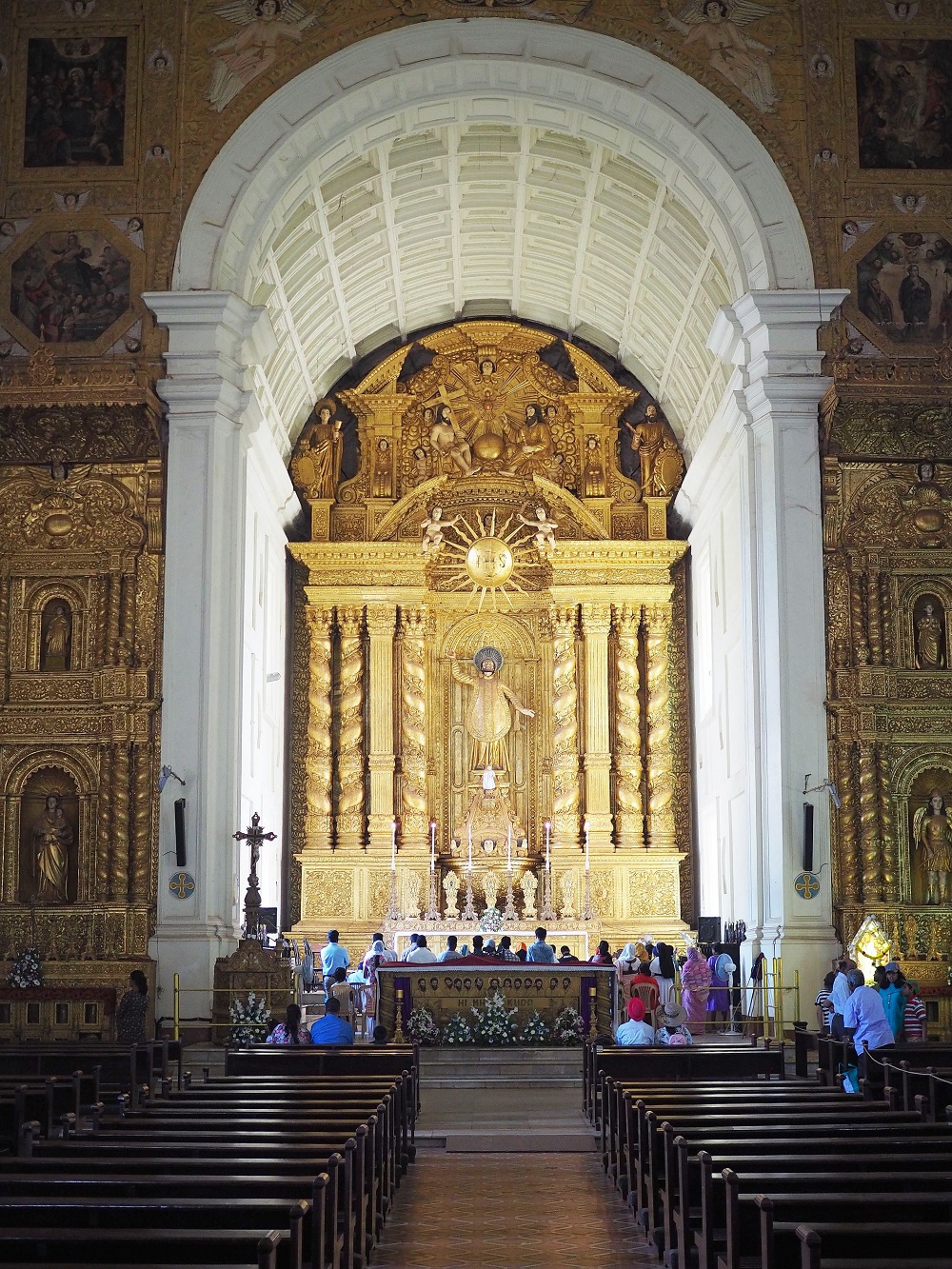
Old Goa — 10km east of Panaji — was once the capital of Portugal’s entire Asian empire. At its peak in the 1600s, it was one of the most consequential cities in the world: a hub of trade, religion, and colonial administration with a population larger than either London or Lisbon. The Inquisition operated here. The first printing press in Asia was installed here. Plague and malaria emptied the city within a century of its peak, and jungle slowly reclaimed the residential areas. What remains is a cluster of 16th and 17th-century churches so structurally intact that UNESCO listed them in 1986 — and almost all are free to enter.
| Church | Built | Entry | Key Feature |
|---|---|---|---|
| Basilica of Bom Jesus | 1605 | Free | Preserved body of St. Francis Xavier; finest Baroque interior in Goa |
| Sé Cathedral | 1619 | Free | Largest church in Asia; famous Golden Bell; 14 side chapels |
| Church of St. Francis of Assisi | 1661 | Rs 15 (museum) | Portuguese gravestones with heraldic coats of arms; archaeological museum inside |
| Church of Our Lady of Immaculate Conception | 1541 (rebuilt 1619) | Free | The white baroque church on every Goa postcard; still an active parish |
The body of St. Francis Xavier
The Basilica of Bom Jesus gets the most attention because it holds the relics of St. Francis Xavier, a Jesuit missionary who died in 1552. His body has been on public display ever since and has not fully decomposed — a fact that attracts pilgrims, historians, and the straightforwardly curious in equal measure. The remains sit inside a silver casket made by a Florentine sculptor, elevated on a marble platform inside the nave.
Every 10–12 years, Goa holds an Exposition where the relics are brought down for closer public viewing — the last one ran in December 2026. Entry is always free, but queues during Exposition periods can run two hours.
Practical timing
All churches in Old Goa close midday, typically from 12:30 to 2pm. Go before 11am or after 2pm. The Basilica and Sé Cathedral stand 200 metres apart. The full walkable cluster takes three hours to see properly — less if you skip the information boards, but those boards are where most of the interesting history actually lives.
Shigmo: The Festival Most Goa Visitors Never Hear About
Shigmo is the best reason to visit Goa in March, and almost nobody who visits Goa in March knows it exists.
It’s a Hindu spring festival — technically Goa’s version of Holi, but visually nothing like it. No colour powder. Instead, you get week-long processions through village streets with enormous decorated floats, traditional Goan folk dances (Fugdi, Dhalo, and Goff), and percussion groups that play continuously through the night. The craftsmanship on the floats — depicting scenes from the Ramayana and Mahabharata — takes months of work and is dismantled once the festival ends.
Panaji holds the main city parade, usually in the second week of March. It draws tens of thousands of people but appears in almost no mainstream Goa travel coverage. The 2026 dates will fall around March 14–15 based on the lunar calendar, though this shifts slightly year to year. No entry fee. No tickets. No registration. You show up, stand on the street, and a five-hour parade goes past you.
The village-level Shigmo celebrations — in Ponda, Vasco, and Margao — are smaller and more intimate than the Panaji parade. If you’re staying near any of these towns during the festival period, ask locally which night the neighbourhood procession comes through.
Mapusa Friday Market vs. Anjuna Flea Market: The Honest Answer
Every travel guide sends you to the Anjuna Flea Market. Most don’t tell you it’s now roughly 80% overpriced imported goods from Rajasthan, sold by non-Goan vendors to tourists. If you want to see what Goans actually buy and sell, Mapusa on a Friday is where to go.
What Mapusa Market actually looks like
- Runs every Friday, early morning until early afternoon
- Located in Mapusa town, 13km north of Panaji — reachable by local bus or auto-rickshaw
- No entry fee
- Sells: fresh kokum, Goan chouriço sausages, cashew feni in unlabelled glass bottles, locally grown spices, dried fish, seasonal vegetables, second-hand clothing, and pottery
- Vendors are predominantly Goan farmers and local traders, not tourist-market operators
- Bargaining is expected — but don’t be aggressive about it
Where Anjuna and Arpora still make sense
The Anjuna Flea Market runs every Wednesday from October to April on the beach. The hippie-market version from the 1970s is largely gone, but what remains is genuinely atmospheric — open sea behind the stalls, decent finds in silver jewellery, block-printed textiles, and genuine Goa-Portuguese antiques if you’re willing to dig. Go before 10am to beat the heat and the later tourist crowds. Entry is free.
The Saturday Night Market at Arpora — run under the Ingo’s brand — charges Rs 200 entry and operates from roughly 6pm to midnight with live music. It’s a curated craft and food market: more expensive than Mapusa, more enjoyable as an evening out. Different purpose entirely. Don’t use it as a substitute for Mapusa.
The verdict
Mapusa teaches you about Goan food culture. Anjuna and Arpora teach you about Goa’s expat economy. Both are interesting for different reasons. But if you only have one morning and want something you genuinely cannot replicate anywhere else in India, Mapusa on a Friday is the answer.
Ancestral Goa Museum in Loutolim: The Most Honest Cultural Experience in the State
Loutolim is a village 20km from Margao that almost every Goa itinerary skips. It has more surviving 18th-century Portuguese mansions per square kilometre than anywhere else in the state. The Ancestral Goa Museum — locally known as Big Foot — sits at its edge.
Most cultural museums at Indian tourist destinations are dry collections of artefacts in unlabelled glass cases. The Ancestral Goa Museum is neither of those things, and that difference matters.
This is a 4-acre open-air museum created by Maendra Alvares, a local Goan artist. Over several decades, Alvares collected tools, furniture, kitchen equipment, and domestic objects from Goan families who were modernising and discarding their old things. The result is a specific, deeply personal collection: life-size recreations of 19th-century Goan tradespeople, a working pottery area, a traditional rice-pounding setup, and a 3,000-year-old laterite sculpture of Shantadurga that predates the Portuguese arrival by millennia.
Entry costs Rs 150 per adult.
What’s actually worth your time inside
The laterite Shantadurga sculpture is the most significant object in the collection — physical evidence of the sophisticated Hindu civilisation that existed in Goa before 1510. Beyond that: complete 19th-century Goan kitchen setups, traditional toddy-tapping equipment, photographs of Catholic Goan families from the early 1900s, and a scaled model of a traditional Goan village showing how Hindu and Catholic communities lived side by side after the forced conversion period ended. It’s a more complex picture of Goan history than any church or beach conveys.
Combining the museum with the rest of Loutolim
Loutolim itself has several surviving 18th-century Portuguese mansions. The most significant is Casa dos Miranda (Miranda House), a private heritage property that occasionally opens for guided tours. Hours vary by season — ask at the museum when you arrive, since they usually know the current schedule.
Budget 90 minutes for the museum. Don’t rush the outdoor sections. The indoor galleries are interesting, but the life-size village recreations and the open-air laterite sculptures are what most visitors remember long after they’ve left.
