
International Airport Guide: The 90-Minute Rule That Prevents Missed Flights
You booked a 10:40 AM flight from Frankfurt to Chicago. Your hotel is 25 minutes from the airport. You leave at 7:30 AM thinking you have plenty of time. Then you hit terminal confusion, a 45-minute security queue, and a gate that closes 20 minutes before departure. You miss the flight. This is not a rare story — it happens every day at major international hubs because travelers misunderstand one critical number: 90 minutes.
This guide exists to fix that misunderstanding. It explains what the 90-minute rule actually means, where it fails, and how to adjust it for specific airports, airlines, and situations. No generic advice. Just the mechanics of how international airports actually process passengers.
The 90-Minute Rule Explained: What Airlines Don’t Tell You
Airlines typically recommend arriving 3 hours before an international flight. That recommendation is conservative, designed to protect the airline from liability when you miss a flight. The actual minimum processing time at most international airports is closer to 90 minutes — but only if everything goes right. And things rarely go right.
The 90-minute rule works like this: from the moment you step into the terminal, you need roughly 15-20 minutes for check-in and bag drop, 20-30 minutes for security, 15-25 minutes for passport control (if exiting the Schengen zone or entering a new immigration area), and 10-15 minutes to walk to your gate. That totals 60-90 minutes. The rule holds — barely — at mid-size airports like Dublin or Lisbon during off-peak hours.
It collapses at major hubs. Heathrow Terminal 5 routinely sees security queues exceeding 40 minutes during the 6-9 AM departure wave. Frankfurt Airport has documented average security wait times of 35 minutes in Terminal 1, with spikes to 70 minutes during summer. Singapore Changi is faster — typically 10-15 minutes — because of automated immigration gates and distributed security checkpoints. The rule is not universal. That is the point.
When the 90-Minute Rule Fails
- Peak departure windows: 6-9 AM and 4-7 PM local time at European hubs. Security queues double or triple.
- Passport control for non-citizens: US-bound flights from Europe require additional document checks at the gate. Budget an extra 15 minutes.
- Terminal changes: At Frankfurt, a connection between Terminal 1 and Terminal 2 requires a shuttle bus that takes 10-15 minutes. At Heathrow, changing from Terminal 5 to Terminal 2 or 3 requires a train and can take 25 minutes.
- Bag drop closures: Most airlines close bag drop 60 minutes before departure. If you arrive 90 minutes before and the queue takes 35 minutes, you miss the cutoff.
Airport-Specific Wait Times: A Comparison Table
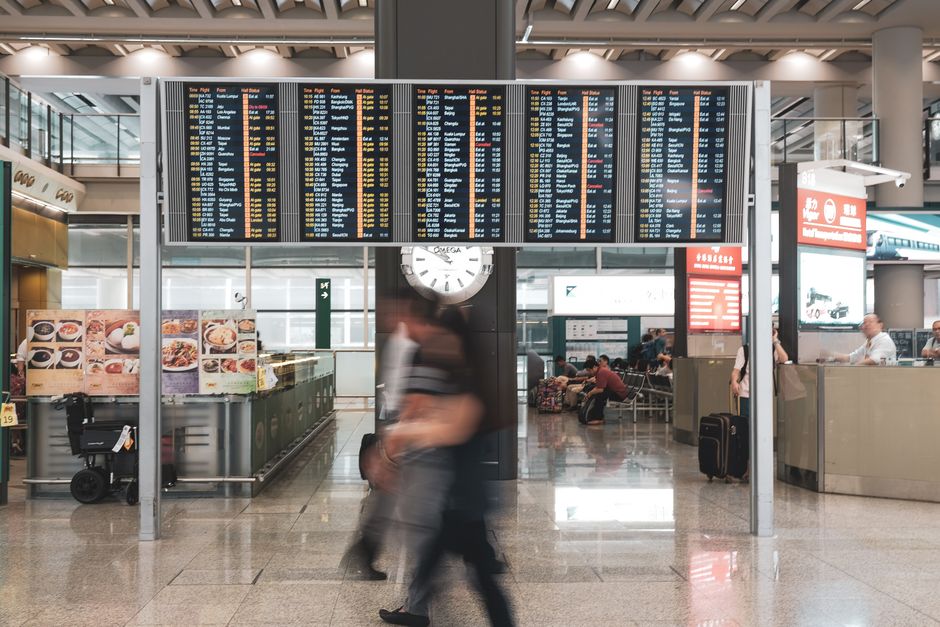
The table below shows average security wait times at major international airports, based on data from airport authority reports and third-party tracking services. These are averages — peak times run higher.
| Airport | Average Security Wait | Peak Wait | Recommended Arrival (International) |
|---|---|---|---|
| Singapore Changi (SIN) | 10-15 min | 25 min | 2 hours |
| Amsterdam Schiphol (AMS) | 20-25 min | 60+ min | 3 hours |
| London Heathrow (LHR) | 25-35 min | 70 min | 3 hours 30 min |
| Frankfurt (FRA) | 25-35 min | 70 min | 3 hours |
| Istanbul (IST) | 15-20 min | 40 min | 2 hours 30 min |
| Dubai (DXB) | 15-20 min | 45 min | 2 hours 30 min |
| New York JFK | 20-30 min | 60 min | 3 hours |
| Tokyo Narita (NRT) | 15-20 min | 35 min | 2 hours 30 min |
Schiphol deserves special attention. In 2026 and 2026, the airport experienced severe staffing shortages that produced queues stretching outside the terminal. The situation improved in 2026, but the airport still recommends 4-hour arrivals during peak summer periods. That is not marketing. That is operational reality.
What Actually Slows You Down at International Airports
Most travelers blame security for delays. Security is only part of the problem. The real bottlenecks are often hidden in the steps before and after the checkpoint.
The Bag Drop Bottleneck
At many European airports, bag drop is slower than security. Airlines like Ryanair and easyJet operate strict bag drop windows. Ryanair closes bag drop exactly 40 minutes before departure. easyJet closes it 40 minutes before as well. If you arrive at the airport 2 hours before a Ryanair flight and the bag drop queue is 45 minutes, you still make it. But if you arrive 90 minutes before and the queue is 50 minutes, you miss the cutoff. The margin is thin.
Passport Control for Non-Schengen Flights
If you are flying from a Schengen country to the US, UK, or Ireland, you must pass through exit immigration. At Frankfurt, this adds 15-30 minutes. At Madrid Barajas, it can add 40 minutes during the morning US departure wave. At smaller airports like Porto or Valencia, it adds 10 minutes. The difference matters when you are working with a 90-minute buffer.
Gate Location and Terminal Layout
Some gates are simply far away. At Schiphol, walking from security to the farthest gate in the non-Schengen pier takes 20 minutes. At Istanbul Airport, the main terminal is a single building, but gates are spread across a 1.4-kilometer concourse — a 20-minute walk if you are at the far end. At Heathrow Terminal 5, the B and C gates require a transit train that adds 10-15 minutes. Airlines do not warn you about this when you book.
A Smarter Pre-Flight Routine for International Departures
Here is the routine that works. It is not clever. It is just specific.
- Check your airline’s bag drop cutoff before leaving home. This is the single most important number. For Ryanair, it is 40 minutes. For British Airways, it is 60 minutes. For Lufthansa, it is 60 minutes. For Air France, it is 60 minutes. Work backward from that number, not from departure time.
- Look up the airport’s current security wait time. Most major airports publish live wait times on their websites or apps. Heathrow has a live tracker. Schiphol has one. Frankfurt has one. Check it 2 hours before you leave for the airport. If the wait is over 30 minutes, add 30 minutes to your plan.
- Identify your terminal before you leave. Do not assume your airline always flies from the same terminal. At Heathrow, British Airways uses Terminal 5 and Terminal 3 depending on destination. At Frankfurt, Lufthansa uses Terminal 1 but some partner airlines operate from Terminal 2. Check the terminal on your booking confirmation, not your memory.
- Use a digital boarding pass. This skips the check-in desk entirely if you are not checking a bag. For carry-on-only travel, you can go straight to security. That saves 10-15 minutes.
- Know your passport control situation. If you are leaving the Schengen zone, you will need exit immigration. Budget 15-30 minutes for this. If you are flying within the Schengen zone, you skip it entirely.
What Frequent Flyers Do Differently
Frequent flyers do not arrive earlier. They arrive smarter. They use tools that reduce uncertainty.
TSA PreCheck and Global Entry are US programs, but they matter for international travel because they reduce time on the return leg. Global Entry includes TSA PreCheck and provides expedited immigration when returning to the US. The application costs $100 and requires an interview. For anyone taking more than two international trips per year, it pays for itself in saved time.
CLEAR is a separate program that uses biometric screening to skip the ID check line at security. It costs $189 per year and works at many US airports. It does not skip the physical screening — you still go through the metal detector — but it skips the document check queue. At JFK and LAX, that queue can be 15-20 minutes during peak times.
European travelers do not have a direct equivalent to TSA PreCheck, but some airports offer fast-track security for business class passengers or for a fee. Schiphol sells a fast-track pass for €5.50. Heathrow sells one for £12.50. These are worth buying if the standard queue is over 30 minutes.
The most important habit, though, is checking the airport’s live wait time before leaving. Frequent flyers do this instinctively. Occasional travelers do not. That is the difference between a calm morning and a missed flight.
The single most important takeaway: the 90-minute rule is a minimum, not a guarantee, and the only reliable buffer is knowing your airline’s bag drop cutoff plus your airport’s live security wait before you leave home.

Related Posts