Road Trip With Toddlers: The 2-Hour Rule That Prevents Meltdowns
Most toddler road trips fail before you leave the driveway. Not because of traffic or weather. Because parents plan the drive like they’re traveling alone. They map a 7-hour route and think, “We’ll stop when we need to.” Then they spend 4 hours pulling over for diaper blowouts, snack refusals, and full-body screaming fits at a rest stop in Ohio.
Here’s the fix: the 2-hour rule. You stop every 2 hours. No exceptions. Even if the toddler is asleep. Even if you’re making great time. You plan the stops before you leave, you know exactly what happens at each one, and you never, ever push past 2 hours to “just get there faster.” That’s how you lose.
This article covers the actual mechanics: timing, packing, car setup, and the failure modes nobody warns you about. No vague advice. Specific products, specific times, specific plans.
Why the 2-Hour Rule Works When Everything Else Fails
A toddler’s nervous system has a hard limit. After about 90 to 120 minutes in a car seat, the combination of restricted movement, sensory monotony, and low-grade motion discomfort crosses a threshold. Once that threshold is crossed, you’re not dealing with a mildly fussy child. You’re dealing with a dysregulated one. And a dysregulated toddler cannot be reasoned with, bribed, or distracted. You can only wait it out.
The 2-hour rule isn’t about preventing boredom. It’s about getting the kid out of the seat before the threshold is crossed. That’s the entire game.
What Actually Happens at the 2-Hour Mark
At 90 minutes, most toddlers are still recoverable. They’re fidgety but not gone. At 2 hours, they’re at the edge. At 2 hours and 20 minutes, you’ve missed the window. The meltdown is now inevitable, and it will take 30 to 45 minutes of full-body movement to reset. That’s not a rest stop. That’s a hostage negotiation.
Plan your first stop at exactly 90 minutes if your child is under 2. Plan it at 2 hours if they’re 2.5 or older and you’ve done this before. The first stop should be at a place with actual space to run — a park, a school playground, a rest area with a big grass field. Not a gas station parking lot. Gas stations are for fuel. Parks are for toddlers.
How to Calculate Your Real Drive Time
Take your total drive time and add 50%. A 6-hour Google Maps estimate becomes 9 hours with a toddler. The math: 6 hours driving + 3 stops at 30 minutes each + 1 unplanned stop for a diaper emergency or snack negotiation = 9 hours. If you plan for 6 and it takes 9, you’re miserable. If you plan for 9 and it takes 8, you feel like a genius.
Here’s a real schedule for a 6-hour route:
| Time | Activity | Duration | Notes |
|---|---|---|---|
| 8:00 AM | Depart | — | Kid fed, changed, already in seat |
| 9:30 AM | Stop 1: Park/playground | 30 min | Run, climb, snack, diaper |
| 10:00 AM | Drive | 2 hrs | Nap window likely |
| 12:00 PM | Stop 2: Lunch | 45 min | Real food, not gas station junk |
| 12:45 PM | Drive | 2 hrs | Post-lunch drowsiness |
| 2:45 PM | Stop 3: Quick stretch | 20 min | Diaper, water, 5 min of running |
| 3:05 PM | Drive | 1.5 hrs | Final push |
| 4:35 PM | Arrive | — | Done before dinner meltdown window |
The Car Setup That Prevents 80% of Problems
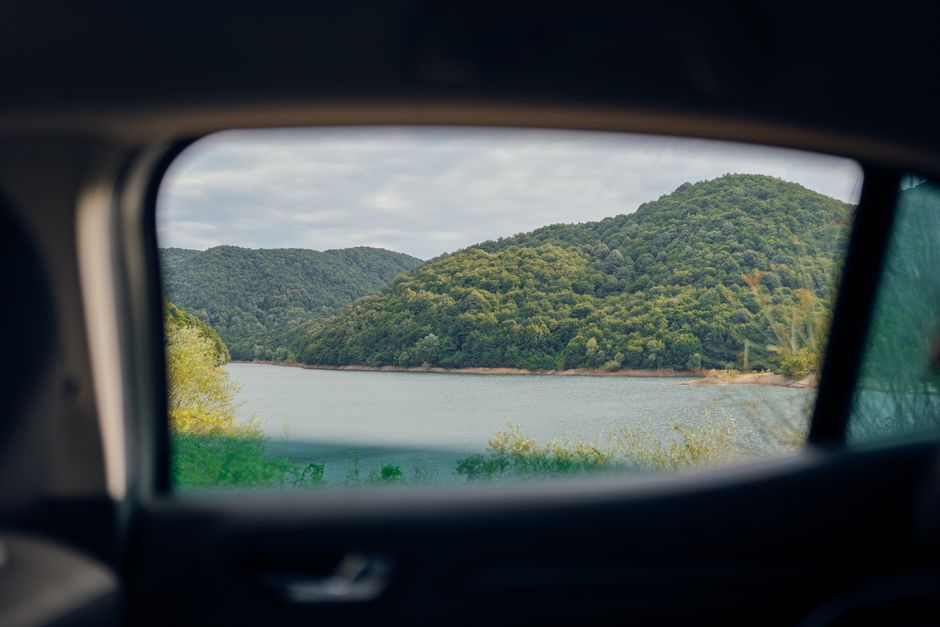
You don’t need a minivan full of gadgets. You need four things within arm’s reach of the toddler, one thing within arm’s reach of you, and a strict rule about what doesn’t come in the car.
What Goes in the Toddler’s Zone
- Snack system: The Munchkin Snack Catcher ($6) is the only snack cup that doesn’t dump Cheerios everywhere. Fill it before you leave. Refill at every stop. Do not hand a toddler a loose bag of anything.
- Water bottle: A spill-proof straw bottle like the Contigo Kids Spill-Proof Tumbler ($12). Leak-proof matters more than insulation. A wet car seat at hour 3 is a crisis.
- One quiet activity: The Melissa & Doug Water Wow ($6) is a reusable water-painting book. No mess, no batteries, no lost pieces. It buys 20 to 30 minutes. Bring three.
- One audio option: The Yoto Mini ($70) is a screen-free audio player that toddlers can operate themselves. Load it with their favorite songs and stories. It’s the single best car investment for kids under 5.
What Goes in the Parent’s Zone
- Wipes. Not a travel pack. A full-size pack. You will use 40 wipes on a 6-hour drive.
- A change of clothes for the toddler AND a shirt for you. Spit-up, spilled milk, exploded diapers — one of these will happen.
- Two empty plastic bags. For the clothes that just got destroyed.
- One small trash bag. Hang it from the back of the passenger seat.
The Car Seat That Actually Fits
Most car seats are too big for comfortable long-haul driving with a toddler. The Graco Extend2Fit ($230) has a rear-facing weight limit of 50 pounds, which matters if you have a big kid. The Diono Radian 3R ($200) is narrower, so it fits three-across in most sedans. Both are legit. If your kid is over 40 pounds and forward-facing, the Britax One4Life ($400) is the most comfortable for sleeping. A toddler who sleeps in the car is a toddler who doesn’t scream. That’s worth $400.
The Packing List Nobody Tells You About
Forget the Pinterest packing lists with 47 items. Here’s what actually matters, in order of importance:
- Diapers and wipes: Count the hours, divide by 2, add 3. That’s your diaper count. Wipes: one full pack per day, minimum.
- Snacks: Pack 2x what you think you need. Variety matters more than quantity. A toddler who refuses goldfish at hour 4 will accept a fruit pouch. A toddler who refuses the fruit pouch will accept a cheese stick. You need options.
- Change of clothes: For the toddler, yes. For you, also yes. Blowouts happen. Spilled coffee happens. Both happen on the same day.
- Portable potty: If your toddler is potty trained or training, the Oxo Tot 2-in-1 Go Potty ($22) is non-negotiable. It works as a standalone potty and as a seat on a regular toilet. The first time you’re 20 minutes from the nearest rest stop and your kid announces they need to go NOW, you’ll understand.
- First aid basics: Band-aids, children’s acetaminophen, a thermometer. Not a full kit. Just the things you’d need before you can get to a pharmacy.
- One comfort item: Whatever they sleep with. Not a backup. The actual one. If you forget it, you’re buying a replacement at a random Walmart at 9 PM and it won’t be the same.
Here’s the thing about packing: you will overpack clothes and underpack snacks. Every single time. Fix that ratio before you leave.
When NOT to Do a Long Road Trip

Some trips aren’t worth it. If your toddler is in the middle of a sleep regression, teething molars, or recovering from an illness, a 6-hour drive is a bad idea. Reschedule. The trip is supposed to be fun. If you’re starting from a deficit, you won’t catch up.
Also: do not drive through the night. Parents think, “The kid will sleep, we’ll make great time.” What actually happens: the kid sleeps for 2 hours, wakes up disoriented in a dark car, screams for 45 minutes, then falls back asleep. Meanwhile, you’re driving at 2 AM on 4 hours of sleep with a screaming child in the back. That’s not a hack. That’s a safety hazard.
If the drive is over 8 hours, fly or split it into two days. The BabyBjorn Travel Cot Light ($250) makes hotel sleep actually work for toddlers under 3. It sets up in 30 seconds and packs down to the size of a carry-on. If you’re doing a multi-day road trip, this is the single best purchase you can make. A toddler who sleeps well in a hotel is a toddler who can handle another day in the car. A toddler who doesn’t sleep well will make day 2 a living nightmare.
What Actually Ruins Trips (And How to Avoid It)
After 15 years of hearing road trip disaster stories, the same three failures come up over and over. Here they are, with the fix.
Failure 1: The first stop is too late. Parents push the first stop to 2.5 or 3 hours because the kid seems fine. The kid is not fine. The kid is saving up. Stop at 90 minutes, even if it feels unnecessary.
Failure 2: Screen time backfires. Parents load up an iPad with shows and think they’ve solved the problem. Then the kid watches 3 hours of Peppa Pig, gets overstimulated, and melts down harder than if they’d never had the screen. Limit screen time to the final 60 to 90 minutes of each leg, not the beginning. Use it as a rescue tool, not a default.
Failure 3: The last leg is too long. Parents front-load the driving and leave a 3-hour final stretch. By then, the toddler is done, the parents are done, and everyone’s just white-knuckling it. Keep the final leg under 90 minutes. Arrive before the 4 PM meltdown window.
The single most important takeaway is this: a successful toddler road trip is not about the destination — it’s about managing the 2-hour windows between stops. Master that rhythm and you’ll actually enjoy the drive.

Related Posts